
Selective, Not Quiet: What Q1 Tells UK Business Owners
UK deal volumes fell in Q1 2026 while values rose. We look at what that really means for owner-managed businesses, and why preparation now matters more than timing the market.

UK deal volumes fell by 30% in the first quarter of 2026, according to Experian MarketIQ, while aggregate disclosed value rose by 36%. Read quickly, that looks like a market which has gone quiet at the bottom and busy at the top.
The detail tells a more useful story, and a more encouraging one for owner-managed businesses than the headline suggests.
The quarter is busier than it looks
First, the Q1 figures are not final. Experian notes that reporting lags mean Q1 volumes are understated, with a clearer picture expected later in the year; its report was compiled on 27 April, barely four weeks after the quarter closed. The Office for National Statistics treats its own Q1 2026 release the same way, describing the estimates as provisional and subject to revision. Experian is explicit that volumes are understated, so the quarter is likely to read better in hindsight than it does today.
Second, the slowdown is not evenly spread. Experian records deal activity as concentrated in the sub-£10m range, with the UK's core SME segment continuing to account for a significant share of volume. The regional detail bears that out: in Wales, sub-£10m transactions rose 88% year on year, from eight deals to 15. Dealsuite's UK and Ireland M&A Monitor, based on responses from 106 advisory firms, found the share of mid-market deals below £2.5m rising from 33% to 42% over the second half of 2025, while deals of £10m and above fell from 25% to 15%. The smaller end of the market is not where the pressure is being felt.
Trade buyers are setting the pace
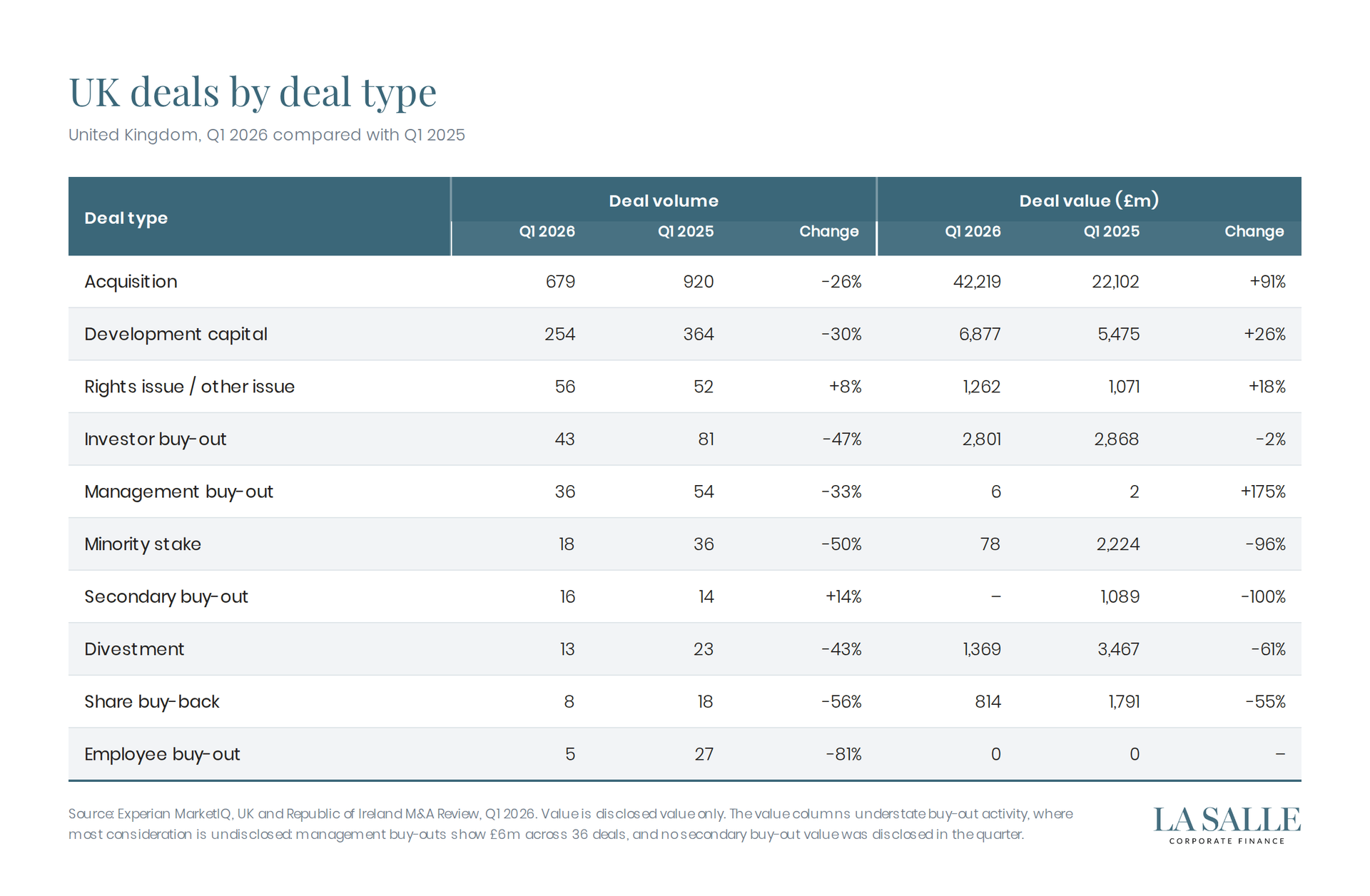
The clearest shift in the quarter is who is doing the buying. Acquisitions accounted for roughly 60% of the deals Experian recorded by type and 76% of all disclosed value, up from 54% a year earlier, with corporate acquirers making up over 79% of Midlands activity and 77% of deal volume in the South West.
Classic buy-outs were fewer, with investor buy-outs down 47%, but that line understates how much investor capital was actually at work.
Development capital values rose 26% to £6.9bn, and Experian records private equity backed platforms such as Xeinadin, BK Plus and Affinia driving consolidation across professional services through bolt-on acquisitions, which are counted as acquisitions rather than buy-outs. Secondary buy-outs were also the only buy-out type to grow, up 14% nationally and doubling in London, which points to sponsor exit routes reopening.
Overseas interest has not gone away
Cross-border appetite remains a live part of the picture. ONS data for Q1 2026 records 163 inward acquisitions of UK companies worth £14.2bn, against 72 outward deals worth £4.7bn, so the UK continues to attract considerably more interest than it exports. Experian's regional commentary points the same way, with US acquirers the most active overseas buyers in London, Yorkshire and Humber and the East of England, and German buyers leading in the South West with eight transactions. For a good number of owners, the best-priced buyer will not appear on a domestic list at all.
Where the positive signals are
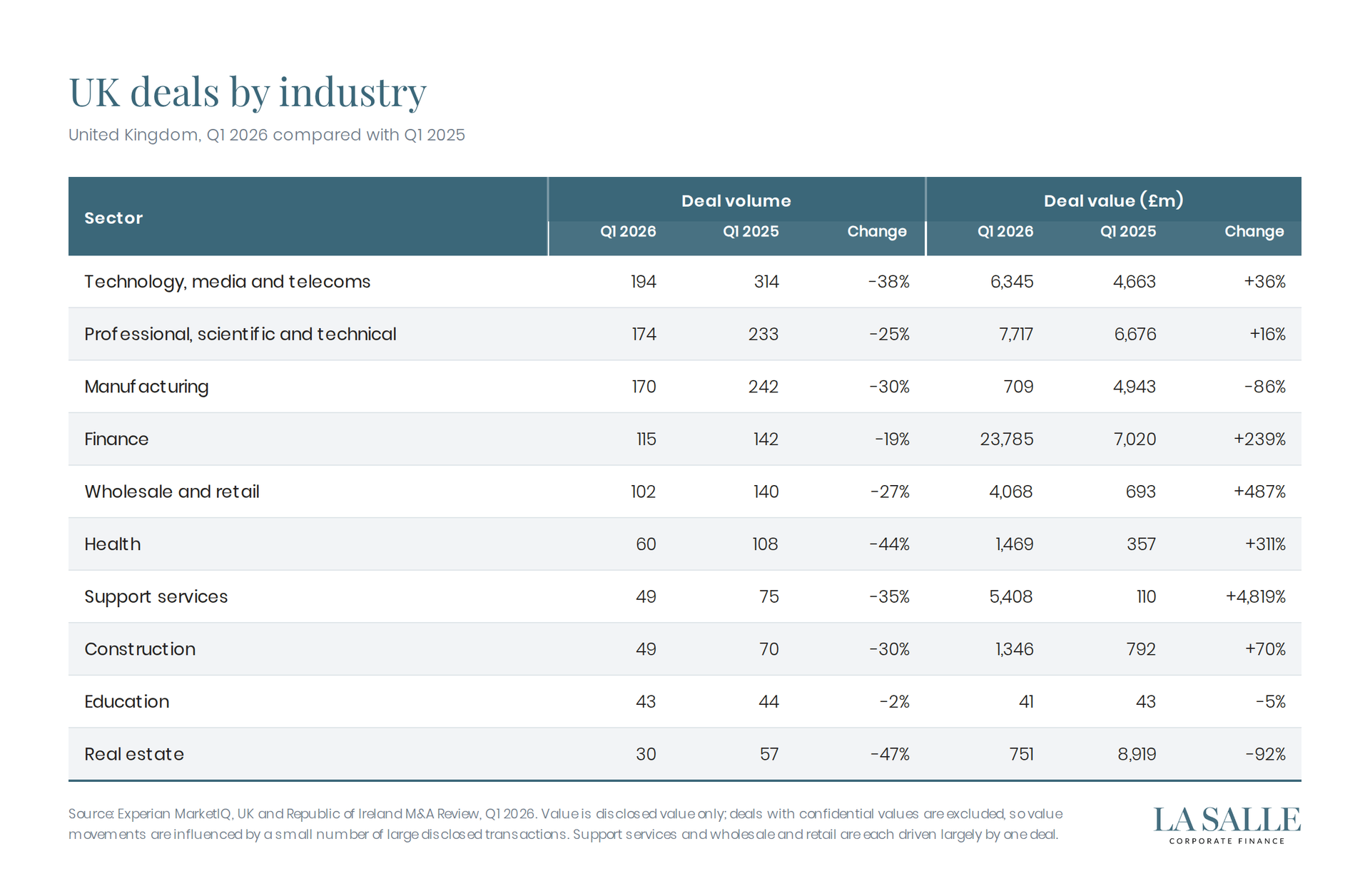
Sector by sector, the encouraging signs are practical rather than headline-grabbing. Professional services values rose 16% as accountancy consolidation continued, with acquisitive platforms completing multiple bolt-ons through the quarter. Construction values rose 70% nationally, and deal volumes rose 33% in the North West and 75% in Yorkshire and Humber. Hospitality staged a genuine recovery in the North West, with nine transactions worth a combined £16.7m against a single deal in the same quarter last year. Education was the steadiest sector of all, with volumes essentially flat at a 2% decline.
What this means for owners
The thread running through all of it is selectivity rather than absence. Experian's research manager points to more extensive due diligence and longer periods between announcement and completion, reflecting a more cautious and disciplined approach to execution. Buyers have capital and they are deploying it, but they are asking harder questions first. Dealsuite's figures show what that looks like in practice: an average EBITDA multiple of 5.4, but 3.3 for a business with £200,000 of EBITDA against 8.4 for one with £10m. Scale matters, and so does the quality of what a buyer finds when they start looking.
None of that is within an owner's gift to change overnight, but preparation is. Clean reporting, a credible growth story, a management team that is not wholly dependent on the founder, and a buyer list that reaches beyond the obvious domestic names all shorten a process and protect value through it.
At La Salle, we work with owners well before a sale begins, so that a more selective market works in the seller's favour rather than against it. When buyers are choosing carefully, being the business that is easy to choose is worth considerably more than trying to time the cycle.
More News & Deals...









Our 'Focus On' Resource Series...